Showing posts with label politics. Show all posts

Friday, May 15, 2009

It's really weird that we still call him Czar

My sister and I recently had a conversation about three-strikes-your-out laws and a legal system bursting at its seams. In my opinion, one of the functions of three-strikes-your-out laws (and mandatory minimum sentencing) is to speed up the sentencing process in an attempt to unclog our courts. Sis (and H) convincingly argued that it's not appropriate to ease the burden on our court system by taking short-cuts with defendants' trials and sentencing. Both of them proposed throwing more money at our legal system, but frankly, I don't think that's likely as there are a lot of things that need a lot of money right now. One of the solutions my sister and I discussed is the possibility of legalizing or decriminalizing drugs as a way to deal with judicial and prison systems that are completely overwhelmed. It turns out that recently her law school's chapter of the ACLU had hosted Jake A Cole.

Cole is passionate in his belief that the drug war is steeped in racism, that it is needlessly destroying the lives of young people, and that it is corrupting our police. Cole's discussions give his audience an alternative perspective of the US war on drugs from the view of a veteran drug-warrior turned against the war.

Cole is part of Law Enforcement Against Prohibition (LEAP), which recently featured a letter to our new head of the White House Office of National Drug Control Policy, Gil Kerlikowske. While the letter voices some concerns LEAP has with some Kerlikowske's statements, the Wall Street Journal had a story yesterday about his plan to "end the war on drugs." The article states,
The Obama administration is likely to deal with drugs as a matter of public health rather than criminal justice.
Already, the administration has called for an end to the disparity in how crimes involving crack cocaine and powder cocaine are dealt with. Critics of the law say it unfairly targeted African-American communities, where crack is more prevalent.
The article goes on to say,
The drug czar doesn't have the power to enforce any of these changes himself, but Mr. Kerlikowske plans to work with Congress and other agencies to alter current policies.
I think it will take some major political capital to convince members of Congress who are up for re-election and worried about being smeared as weak on crime to get behind some of these changes, but I also think we're getting closer. Something to keep an eye on.

Also, did you know that the ACLU has a blog?

And finally, check out Lock-Up from This American Life.

Saturday, June 7, 2008

Our powers combined

I've stayed pretty quiet about the Democrat nominating process this year, both here and out "in real life." The general quiet was for several reasons; first, I knew that I would support whoever actually won the nomination in the end and I would have been happy with either Barrack Obama or Hillary Clinton; and second, as a I wrote a couple of times, the tone of the conversation around the nominating process and the candidates disturbed and saddened me, and honestly, I was afraid to get involved. I was afraid I might write something and then see it twisted somewhere else, and much, much more shamefully, I was afraid of making a mistake or offending people.

[Sidenote: If I write something that offends you, in this or any other post, let me know. We may never see eye to eye, but I want to make an effort to hear where you are coming from.]

I probably would have overcome my fear if I thought I had something new to bring to the table, but there were tons of voices of reason out there, setting the record straight better than I ever could.


There is a whole other, and larger, reason though, that I haven't been being that loud about the primaries and probably will continue to stay relatively quiet during the general election. Here I am November, 2004:

Please note, if it wasn't obvious to you, the John Kerry button.

I've written and deleted the next paragraph a couple of times, because I'm not sure how to say what I want to say here.

I was so shocked and sadden when Kerry lost the 2004 general election (and Bush won the popular vote). I had been involved in Kerry's campaign as a very low-level volunteer in Pittsburgh and I have to admit, that though many people weren't moved or motivated by Kerry, I was. But it wasn't because "my" candidate had lost that I felt devastated that night; it was because of the story that came out of that election. For weeks after Kerry lost, the story that dominated the airwaves was that the people that had voted for Bush (or rather, against Kerry?) had been motivated by "family values." LGBT groups were told that they had cost the democrats the election because they had "pushed" the "gay-marriage issue." In addition to being code for homophobic, I felt (knew?) family values also stood for "pro-life," "believes strongly in enforcing gender differences," and "transphobic" among other things.

What the 2004 election brought home to me was that people hated me and hated people like me. This was a significantly different realization from knowing that people disagreed with the things I thought and the way that I saw the world. When I saw the presidential election as a war of ideas, as in we all get together and vote for the person with the best ideas, it was easy to keep myself out of the equation or at least keep some distance. Sometimes republicans would win, sometimes democrats would win; it was a serious game, but still a game. When, however, I came to see the presidential election as an opportunity for a public referendum on whether or not, I and the people I love, are truly equal in the eyes of their fellow citizens, whether or not we are hated, I realized that it was my body and my future that was at stake (along with the bodies and futures of people I care about), not (just?) my ideas. Not a game.

It's hard for me to write or talk casually about the election. Maybe because it is so personally important to me, I should be using that to write and talk forceful about it, but I am so scared of feeling the way I felt in November 2004 all over again, hated, rejected, and in some degree of danger, that it's difficult for me to allow myself to become emotionally invested again.

[Sidenote: I know it's a result of my privilege that my belief in the political system took it's first serious hit in this regard when I was in my 20s. There are plenty of people in our nation and others whose general population and government has always treated them like an enemy.]

We all have a lot at stake in this election (for example: I think the encroachment on our civil liberties is a pretty serious thing for all of us as well as many many other issues [Iraq war, anyone?]), and it would be a huge mistake for us to ignore the lesson of 2004. To me, the lesson of 2004 isn't to avoid putting issues on the national stage that will arouse people's anger and hatred, but rather, that we must acknowledge that emotions play an integral part in people's political decision-making process (and I would argue in all of their decisions). Harnessing people's deep feelings is not a bad thing because it clouds judgment (does it? I've been able to be angry/loving/sad and right at the same time before...) or just a smart campaign move, to acknowledge the emotional stake we all have in the political process is to acknowledge our humanity. I don't know what a purely rational being would look like, but I have a feeling it would be a lot less benevolent than Data.

When I think of Barrack Obama, I often think of what is arguably the best line from one of his speeches, "In the unlikely story that is America, there has never been anything false about hope." I think he has picked a pretty wonderful emotion to bring people out to the polls November 2009. Both because I have acknowledged that my emotions don't negate my ability to think rationally and because I believe that our emotional compasses can be used to guide us to the best in ourselves, I am not ashamed to say that I will be voting with my heart in November. (I just might not be blogging about it.)


Lauren (right) and Me, 2005
This post is the result of some discussions, I've had with my friend Lauren this past week and I've totally lifted some of her ideas. Thank you, Lauren.

Tuesday, May 6, 2008

I hope we don't have to rip out the foundation

My friend Jake invited me to go to North Carolina today to campaign. I couldn't go because I couldn't take off work on such sort notice.

I also couldn't go because of everything Jay Smooth says here. This Ill Doctrine post, btw, is also a pretty good summation of why I don't really write about the democratic nomination process at the moment. Not gonna be more noise about this. (Don't take this as a criticism if you are writing about the nomination process. I love a lot of what I read; I just don't think I have anything new to bring to the table).

Tuesday, February 5, 2008

Dollars and Sense

I meant to write about this when I read it, but I've been having computer trouble at home and I've been too busy at work. (When I'm having busy days at work I want to spend my lunch hour away from the computer.)

I've noticed this all over, but last Sundays this paragraph from a New York Times article about Obama's South Carolina victory caught my eye:

"A heightened anxiety about the nation’s economy was at the center of the primary fight here. More than half the voters said it was the most important issue facing the country, overtaking health care or the war in Iraq." (Emphasis mine.)

From this quote, I assume pollsters/reporters were asking voting South Carolinians, "What issue do you care the most about, the economy, health care, or the war in Iraq?" This question (or the quote that results from it) fails on two counts: (1) It perpetuates the idea that the economy, health, care, and the war in Iraq are separate issues and (2) it is practically empty of meaning as I don't know what aspect of each issue they respondents are concerned about, leaving me to fill in whatever I am concerned about with that issue.

There will always be buzzwords summing things up into neat little categories that allow everyone to think that we're talking about the same thing when we're not. What concerns me most is the first failure. The economy, health care, and the war in Iraq are connected to each other, not separate issues.

Dwight Eisenhower said, "Every gun that is made, every warship launched, every rocket fired, signifies in the final sense a theft from those who hunger and are not fed, those who are cold and are not clothed."

If you're looking for the actual numbers the American Friends Service Committee (via Iraq Today) spells it out for us here.

Sunday, January 13, 2008

Housing is a Human Right

In her book, The Shock Doctrine, Naomi Klein includes a chapter about New Orleans. After examining the mismanagement of disaster relief work, that the government outsourced to private contractors (using tax payers' money, if that's not clear), Klein writes

"The attacks on the disadvantaged, carried out in the name of reconstruction and relief, did not stop there. In order to offset the tens of billions going to to private companies in contracts and tax breaks, in November 2005 the Republican-controlled Congress announced that it needed to cut $40 billion from the federal budget. Among the programs that were slashed were student loans, Medicaid and food stamps. In other words, the poorest cities in the country subsidized the contractor bonanza twice---first when Katrina relief morphed into unregulated corporate handouts, providing neither decent jobs nor functional public services, and second when the few programs that directly assisted the unemployed and working poor nationwide were gutted to pay those bloated bills."


She goes on to write about the lack of progress in New Orleans, two years after Katrina hit. She writes,
"The vast majority of publicly owned housing projects stood boarded up and empty, with five thousand units slotted for the demolition by the federal housing authority...New Orleans' powerful tourism lobby had been eyeing the house projects, several of them on prime land close to the French Quarter.
Endesha Juakali helped set up a protest camp outside on of the boarded-up projects, St. Bernard Public Housing, explaining, 'they've had an agenda for St. Bernard for a long time, but as long as people lived here, they couldn't do it. So they used the disaster as a way of cleansing the neighborhood when the neighborhood is weakest...This is a great location for bigger houses and condos. The only problem is you got all these poor black people sitting on it!'"


As I read Klein's chapter on New Orleans, I was reminded of something that I had read on La Chola's blog before I went on vacation for the holidays. She has several posts on the Public Housing advocates protesting the New Orleans City Council meeting convened to approve the "untimely demolition of the 4 largest housing developments during an unprecedented housing crisis in this city." (Quote on her blog came from here.) I urge you to watch the video in her post Public Housing Advocates Attacked part 4 (which is linked above) as well as check out the link to the video of the protesting outside of the court house.

Think New Orleans provides a round-up of some links to blogs covering the controversy here.

The Coalition to Stop Demolition (I may have the name wrong, it may be called Defend New Orleans Public Housing) provides a Fact v. Myths page and a Demolition Fact Sheet. The home page provides regular updates of the Coalition's work.

In its latest update, the coalition writes,

"The City Council approved demolition plans for the four major housing developments in late December. Hundreds of people were locked out of the meeting. About a dozen people were arrested for loudly demanding that the council let people in to the empty seats. Police used pepper spray and tasered several protestors. The Council urged HUD to develop one for one replacement of affordable housing and asked for quarterly reports.

The Mayor of New Orleans has promised that there will be no demolition at Lafitte or St. Bernard until HUD shows a full-funded plan for one for one replacement of affordable housing. He announced he would allow demolition to begin at B.W. Cooper and C.J. Peete as soon as he was provided with a Memorandum of Understanding between the HUD and the residents.

Demolition on St. Bernard and Lafitte has not started. Demolition has started on C.J. Peete and B.W. Cooper"


Please check out their calls to action here. Their call for action includes urging U.S. Senate Committee on Banking Housing and Urban Affairs to finishing deliberating on Senate Bill 1668: Gulf Coast Housing Recovery Act of 2007. The bill has to get through the committee before it can be voted on in Congress (and many bills never make it out of the various committees, so it's important to let them know which ones are a priority!). This form will allow you to contact the committee with a statement in support of SB 1668.

Wednesday, January 9, 2008

It's time to have a talk (aka LALALA I CAN'T HEAR YOU)

Ever since I saw this piece by Gloria Steinem about Hillary Clinton and the role of sexism in her campaign, I have been passing it around to friends. Well, after reading this piece by Angry Black Bitch and scrolling through the comments accompanying the post, I have to say I'm completely ashamed I didn't give more thought to Steinem's piece.

I know where Steinem's piece came from. As I glance around on the internet this morning, I see a lot of backlash against Clinton taking the form of sexist attacks. And that makes me angry, sad, and afraid.

However, even with Steinem's disclaimer that she knows all about the intersections of racism and sexism, the article still reads like this: "Obama, as a black man, has an easier time getting the democratic nomination than Clinton, as a white woman." This is a dangerous game because even as Steinem's disclaimer sits there shouting about how tangled up identities are, the rest of her article claims to separate out identities so neatly that supporting Clinton is supporting the (mythical single) cause of all women/feminism. This game is going to lead to a lot of shouting, a lot of deeply hurt feelings, and absolutely no resolution.

I am all for having discussions about the intersections of race and gender and I'm not about to tell people when they can and cannot have these discussions. I am just not looking forward to having this "discussion" played out on the national stage through presidential primaries and the subsequent presidential race. I'm apprehensive about this, mainly because I don't think it will be a discussion at all. Discussion requires an attempt to understand another person's opinion. I don't know if you've been on the internet lately, read a newspaper, turned on your television or radio, or stepped outside, but there's not a lot of that going on.

I see a lot of conversations about who the candidates are in these terms: Clinton is a woman, Obama is black, Huckabee is a preacher, Romney is rich, Kucinch/Paul are the outsiders. These handles tell us something about the candidates, but not much. The also tell us something about the candidates' supporters, but, again, not much. And I think, perhaps, they disguise a lot more than they tell. We are told again and again that voters care more about superficial aspects than they do about the "issues." Even when we care about the issues, our interest can supposedly be summed up in one easy phrase, "Change." How are voters supposed to care deeply about the issues when we are force-feed this cliff-note version of things? What does change mean? What do we mean when we say people support/don't support Clinton because she's a woman? What do we think being "a woman" means? What do we think being black means? What do we think being an white means? What do we think being rich means? What do we think being an outsider means? What do we think "we" or "the nation" means? WHAT ARE ALL THESE WORDS CODE FOR?

Sunday, December 23, 2007

Part 1

Spoiler alert: If you are still waiting to see 1962's Manchurian Candidate, this might not be the post for you.

I'm about 1/4th of the way through Naomi Klein's new book "The Shock Doctrine: The Rise of Disaster Capitalism" (thanks, Lauren, for the xmas gift!). Klein explores the links between disasters (whether state-created or natural) that befall a country and the privitization of public institution (twin shocks, to borrow her language). In the first chapter, Klein describes how the CIA came to use Ewan Cameron's psychological research in the 1950s. She writes of a meeting between different intelligent agencies and academic in 1951.

Klein writes,
"The subject of the meeting was growing concern in the Western intelligence community that the Communists has somehow discovered how to 'brainwash' prisoners of war. The evidence was the fact that American GIs taken captive in Korea were going before cameras, seemingly willingly, and denouncing capitalism and imperialism. According to the declassified minutes from the Ritz meeting, those in attendance...were convinced that Western powers urgently needed to discover how the Communists were extracting these remarkable confessions. With that in mind, the first step was to conduct 'a clinical study of actual cases' to see how brainwashing might work. The stated goal of this research was not for Western powers to start using mind control on prisoners, it was to prepare Western soldiers for whatever coercive techniques they might encounter if they were taken hostage."


Last night, I finished watching the original Manchurian Candidate, made in 1962. It's central plot point rests on the fear that Klein describes in the above passage, that the Communists were capable of brainwashing prisoners of war, and then takes it a step further. In the movie the captured platoon doesn't go on television and denounce Western imperialism, but rather, a member of the platoon (Laurence Harvey playing Raymond Shaw) is a sleeper agent, activated as an assassin each time someone suggests to him that he play some solitaire and he sees a queen of diamond.

There are few clues in the movie about how this is accomplished, the main one being that they were brainwashed at a fictional place called the Pavlovian Institute, which suggests that the creators of Manchurian Candidate envisioned brainwashing as being related to behaviorist techniques. Behaviorism involves offering reinforcement to reward or punish specific behavior. As Klein describes the research of Cameron (in 1957 the CIA gave him his first grant), his goal was not to erase specific behaviors, but rather to erase the person entirely and begin again with a blank slate. To achieve this goal, he used new inventions to give extremely intense shock therapy sessions, sensory deprivation, and extended sleep. Cameron was conducting this research on his patients, who were left much much worse off after being in his care.

Klein is very clear in pointing out that the experiments Cameron engaged in with CIA funding "are consistently described as 'mind control' and 'brainwashing.' The word 'torture' is almost never used."

This semantics game is meant to remind the reader of today, our own on-going semantics game with "enemy combatant" and "enhanced interrogation techniques" and the discussion that seems to have centered itself around the practice of waterboarding. The Manchurian Candidate represents the (not outdated) idea that torture/brainwashing might be used to make a person an effective tool for the interrogators. In the Manchurian Candidate, they created an assassin, today, it's claimed we are trying to create "sources of information." Klein's narrative and Cameron's research state, however, that we are not trying to create a tool, but rather obliterate a person. Rather than the person, it is his/her absolute obliteration that is the tool, the weapon, and the objective is terror.

For more information from a unique perspective about waterboarding please check out this post.

Tuesday, December 11, 2007

Not just a few bad apples

Warning: This post is potentially triggering as it deals with rape.


Via Jezebel: Yesterday ABC posted a news story about a woman named Jamie Leigh Jones. While she was in Iraq working for either Halliburton or its then-subsidiary KBR (the new story isn't clear) Jones alleges was gang-raped by her coworkers. She is suing Halliburton and in her lawsuit she alleges that after being given medical treatment by army doctors who performed a rape kit, she was held under guard in a Halliburton storage container with a bed in it and told that if she left she would lose her job both in Iraq and back in the United States. The rape kit, which contained evidence that she had been both vaginally and anally raped, has disappeared.

After reading about this case, I remembered reading about women who, while serving in the army in Iraq, have been raped or sexually harassed. A quick google search lead me to SuzanneSwift.org, a site that publicizes the story of two women on its home page, Suzanne Swift and LaVena Johnson. The LaVena Johnson story has its own website here. I urge you to read the stories of both women. In particular check out this link from suzanneswift.org: What can I do if I'm being sexually mistreated in the military?

Wednesday, December 5, 2007

Do what I say, not what I do

If you listened to the Bryant Park Project on NPR yesterday (or looked at any major news source I suspect) then you've probably heard about the U.S. intelligence report that concluded that Iran stopped pursuing creating nuclear weapons in 2003. This morning, however, the BPP (and the NY Times) delivered the (rather predictable) news that Bush says that his tough policy towards Iran is justified because Iran has pursued nuclear weapons in the past and will do so in the future if the chance arises.

I don't know if the new U.S. intelligence report is correct. I don't know if Iran intends to get nukes in the future (although, honestly, I suspect that they might). What I do know is that Bush scolding Iran for attempting to create nuclear weapons is the U.S. talking out of both sides of his/her mouth.

November's issue of Scientific American poses the question "Do We Need New Nukes?" as the cover story. In the article, the author, David Biello, explores the Department of Energy (DOE) and the Department of Defense's (DOD) proposal to replace "the W76, which makes up a third of the available warheads" (and according to Biello we have "a stockpile of roughly 10,000 nuclear weapons"). Apparently, W76s have a 30 year life span which is about to expire. The bulk of the article is about explaining and critiquing point by point, DOE and the DOD's argument both for the particular design they'd like to use to replace the W76s (a design filed under the moniker the Reliable Replacement Warhead [RRW]) and for the replacement project in general.

Near the end of the article Biello discusses what I think is the main argument against replacing these outdated warheads. Biello quotes Sidney Drell from the Standford Linear Accelerator Center as saying
If the United States, the strongest nation in the world, concludes that it cannot protect its vital interests without relying on new nuclear weapons for new military missions, it would be a clear signal to other nations that nuclear weapons are valuable, if not necessary, for their security purposes, too.


Or in other words the United States could restart (continue?) the nuclear arms race by pursuing the RRW program.

I'm with Henry Kissinger on this one, who, along with George Shultz, William Perry, and Sam Nunn have issued a statement saying, "We endorse setting the goal of a world free of nuclear weapons and working energetically on the actions required to achieve that goal."

We are sending mixed messages to Iran. While we are demanding (through Condoleezza Rice in the above linked NY Times article) that “Iran...stop enrichment and reprocessing activities," we are simultaneously sending them the message (through actions such as proposing the RRW program) that maintaining a fully function nuclear warhead supply should be the top priority of world powers.

Wednesday, November 28, 2007

Apathy Mask

I recently finished reading "A People's History of U.S.," a book I've mentioned again and again here. As I neared the end of the book (and moved closer to present day) author Howard Zinn argues that the government has become disconnected from the people.

Zinn writes
After the disastrous war in Vietnam came the scandals of Watergate. There was deepening economic insecurity for much of the population, along with environmental deterioration, and a growing culture of violence and family disarray. Clearly, such fundamental problems could not be solved without bold changes in the social and economic structure. But no major party candidates proposed such changes. The "American political tradition" held fast.
In recognition of this, perhaps only vaguely conscious of this, voters stayed away from the polls in large numbers, or voted without enthusiasm. More and more they declared, if only by nonparticipation, their alienation from the political system.


Passages like this really stuck with me. My brother turned 18 a few years after Kurt Cobain killed himself. Interviewers were asking Cobain constantly if "Smells Like Teen Spirit" was about teenage apathy because the story of the time was that my brother's generation, the one right before mine, was apathetic. They didn't vote because they didn't care or so said the media.

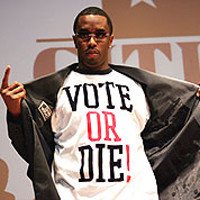
That story continues today. Sean Combs "Vote or Die" Campaign seems based on the idea that if teenagers and people in their twenties just really understood how incredibly important it is to vote, if they were just whipped into a frenzy, they would be voting.

But perhaps apathy masks something deeper and more frightening, despair.

Again, Zinn writes, "In a two party system, if both parties ignore public opinion, there is no place voters can turn."

The apathy story is a good one for the government and the media because it turns nonparticipation into individual moral failing (laziness, being uneducated, selfishness). The "despair" story is a much more difficult one because it requires us to admit the system is failing the people rather blame people for failing to participate in it.

Thursday, November 8, 2007

Can't stop, won't stop

Yesterday the House passed the Employment Nondiscrimination Act (ENDA). (Bad news for the New York Post maybe.) I am very happy that we are one step closer to protection LGB people from discrimination in the workplace, but you'll notice the T is absent Lesbian, Gay, Bisexual, and Transgendered acronym. Some Democrats decided that ditching protection against workplace discrimination for transgendered people was the best way the ensure the bills passage. Understandably some people feel betrayed and pissed. And some people are arguing that transgendered people and their allies just need to be patient and their time will come.

I do believe that eventually transgendered people will be protected from workplace discrimination and I'm willing to hear the counsel "be patient," but not if being patient is supposed to mean, "shut up, sit still, and wait."

As Martin Luther King, Jr., said in his Letter from a Birmingham Jail,

We know through painful experience that freedom is never voluntarily given by the oppressor; it must be demanded by the oppressed. Frankly, I have yet to engage in a direct-action campaign that was "well timed" in the view of those who have not suffered unduly from the disease of segregation. For years now I have heard the word "Wait!" It rings in the ear of every Negro with piercing familiarity. This "Wait" has almost always meant 'Never." We must come to see, with one of our distinguished jurists, that "justice too long delayed is justice denied."


We cannot stop agitating for the things we believe in. If you want to do some agitating in letter-writing form, here's how to find your US House Rep and Senator.

Wednesday, October 31, 2007

I've been worried recently that we are about to declare war with Iran. Everyone tells me that it won't happen because politicians recognize that it would be political suicide and that the army is stretched thin as it is. If we went to Iran, maybe we would have to re-institute the draft. I'm afraid of that too, but I've also been told that that isn't really a possibility because of the notion of "political suicide." Maybe I am totally paranoid and just plan freaking out about current events, but the argument that the draft will not reappear in our life time because politicians don't have enough traction to get it passed the inevitably outraged population has made me wonder about the country's feelings about the draft in the past.

Howard Zinn writes,

On August 1, 1917, the New York herald reported that in New York City ninety of the first hundred draftees claimed exemption. In Minnesota, headlines in the Minneapolis Journal of August 6 and 7 read: "DRAFT OPPOSITION FAST SPREADING IN STATE" and "CONSCRIPTS GIVE FALSE ADDRESSES."...Senator Thomas Hardwick of Georgia said "there was undoubtedly general and widespread opposition on the part of many thousands...to the enactment of the draft law. Numerous and largely attended mass meetings held in every part of the State proptested against it..." Ultimately, over 330,000 men were classified as draft evaders."


According to this website, the US had a population of 106,021,537 in 1920. This website tells me that there were about 24 million draft cards on record, about 23% of the population in 1918. So let's say about 25% of the population was eligible for the draft in 1920. That would mean about 37,170,738 men could have been drafted. So, around 80% of the population that could be drafted were classified as draft evaders during WWI.

Today, the US population is around 303,256,320 people. Since only men have to register for the draft (and pretending still there's a fifty-fifty split), that means about 151,628,160 people are able to be drafted currently (ignoring age restrictions as I did above). So if the draft were put in place and the US classified the same percentage (6.23%) of the population as draft evaders as it did during WWI, that means that 9,446,434.4 men would be classified as draft evaders. Or, to put it differently, the entire population of New York City (men and women) and then some would be classified as draft evaders.

So imagine a scenario in regards to draft evasion happening today like it did during WWI. War is declared, the draft is invoked, there are enough draft evaders to equal (and go over) the population of New York City. Yet we still go to war.

As for the Vietnam War, Zinn writes,

By mid-1965, 380 prosecutions were begun against men refusing to be inducted; by mid-1968 that figure was up to 3,305. At the end of 1969, there were 33,960 delinquents nationwide.

Zinn goes onto write that anti-war feelings continued to grow in the nation, which eventually (along with other factors) led to US withdraw of troops. But not before the draft was used and not before so many people were killed.

My point is, throughout history there has been resistance to the draft. Politicians know that it is going to be unpopular. But that has not stopped them from using the draft in the past and I think we are being naive if we think that negative public opinion will stop them from using the draft today.

Wednesday, October 10, 2007

National Coming Out Day

I didn't get around to posting on Monday, Columbus Day, and I have something I'd like to post about that, but before I do there's something going on tomorrow that I'd like to alert people about.

Tomorrow (Oct 11, 2007) is National Coming Out Day and the twenty year anniversary of the National March on Washington for Lesbian and Gay Rights, accompanied by the AIDs Quilt's first display. The AIDs Quilt is a giant memorial to individuals who have AIDs/HIV or have died from it. In addition to being a memorial, the Quilt is also used to raise money for AIDs service organizations.

This year for National Coming Out Day, the Human Rights Campaign (HRC) is inviting LGBT (lesbian, gay, bisexual, transgendered) people to make videos about coming out and straight people to make videos about being inspired by others coming out. You can check out their website to watch their introductory video and to get information about how to make a video. Also, please check out their Getting Involved/Take Action tab for some information about the HRC's current advocacy campaigns.

***
On to (or back to) Columbus Day:

Howard Zinn tell us that when Columbus landed in the Bahamas, he was
met by the Arawark Indians, who swam out to greet them. The Arawark lived in village communes, had developed agriculture of corn, yams, cassava. They could spin and weave, but they had no horses or work animals. They had no iron, but they wore tiny gold ornaments in their ears.
This was to have enormous consequence: it led to Columbus to take some of them aboard ship as prisoners because he insisted that they guide him to the source of the gold."

These were just the first of Columbus' prisoners. According to Zinn, when Columbus realized that there was not as much gold in America as he had originally presumed and that he would have to send some merchandise back home he and his men
went on a great slave raid, rounded up fifteen hundred Arawak men, women, and children, put them in pens guarded by Spanairds and dogs, then picked the five hundred best specimens to load onto ships. Of those five hundred, two hundred died en route."

Zinn goes on to say
My point is not that we must, in telling history, accuse, judge, condemn Columbus in absentia. It is too late for that; it would be a useless scholarly exercise in morality. But the easy acceptance of atrocities as a deplorable but necessary price to pay for progress...that is still with us. One reason these atrocities are still with us is that we have learned to bury them in a mass of other facts, as radioactive wastes are buried in containers in the earth."


For some interesting history about the Monacan tribe of Native Americans, who Thomas Jefferson once saw passing through Monticello to visit a burial ground of their ancestors, please check this out.

Tuesday, October 2, 2007

Fit to print

I am having one of those days where I am feeling a little helpless. I have a lot of compassion and energy, but I don't really know what to do with it all the time. I do several of the obvious things to help out (donate, volunteer, try to spread the word), but there are some days when I just feel like a hamster on the wheel.

There are several issues going on right now that I have been following. I don't write about some things because I do not feel qualified (yet) to speak about them, but here are some of the things I have been reading about lately:

1. On Feministe, Jill reminds us that the genocide in Dafur is still happening.
2. At Bitch, Ph.D., the doctor fills us in on the protest in Burma.
3. At Majikthise, Lindsey highlights the disturbing report recently released about Blackwater's activities in Iraq.
4. NPR continues its coverage of people in poverty in Iraq.

On a lighter note, I want to post about a couple of comments I have received, because I know not everyone clicks on the comments to see what people have said. Sean Tubbs commented on my post "Moo" to let me know about the Charlottesville Podcasting Network and one of their pieces on local food. I've really been enjoying their "Voice of Poverty" podcasts.

Also John let me know that Better than Television is alive and well in Charlottesville. They are bringing us Head-Roc War Machine this Friday at the Bridge as part of the Columbus Day Symposium.

Saturday, September 29, 2007

For all you Lovers out there

Today I went to the Charlottesville Vegetarian Festival. While there I stopped by the Food Not Bombs' table and picked up some of their materials and signed up to be called to help out. The Charlottesville Food Not Bombs' group serves vegetarian/vegan meals to people in need of food at Tonlser Park at 1pm on Sundays. I have wanted to get involved with Food Not Bombs (this one will take you to their home page) for awhile. (I remember trying to during the summertimes in Pittsburgh to find a Pittsburgh chapter, but I must not have tried very hard [or they must have recently got things up and running] because a quick search took me to this page.) Anyway, check out the Food Not Bombs links above; the group has had some interesting history.

(Thinking about Food Not Bombs today lead me to search for mention of "Better than Television," in Charlottesville. I don't think they exist anymore. Does anyone know? Anyway, that lead me to Slingshot "a quarterly, independent, radical, newspaper published in the East Bay since 1988 by the Slingshot Collective." [And I take issue with the first person's statement that cervical cancer is easily cured if detected early--what about people who do not have access to annual cervical exams?])

Finally, on two totally unrelated notes, I am in the midst of a cold and had my first nose bleed ever today and I'm reading "Remembrance of Things Past" and thought I would share this passage,

At this time of life one has already been wounded more than once by the darts of love; it no longer evolves by itself, obeying its own incomprehensible and fatal laws, before our passive and astonished hearts. We come to its aid, we falsify it by memory and by suggestion. Recognizing one of its symptoms, we remember and recreate the rest. Since we know its song, which is engraved on our hearts in its entirety, there is no need for a woman to repeat the opening strains---filled with the admiration which beauty inspires---for us to remember what follows.

Monday, September 24, 2007

On their backs

I worked nine hours today, which is about average for me. For some reason today felt particularly long, but then, while I was waiting for the trolley this evening I was reading "A People's History of the United States" and I came across this,

1835, twenty mills went on strike to reduce the workday from thirteen and a half hours to eleven hours, to get cash wages instead of company scrip, and to end fines for lateness. Fifteen hundred children and parents went out on strike, and it lasted six weeks. Strikebreakers were brought in, and some workers went back to work, but the strikers did win a twelve-hour day and nine hours on Saturday.


And then later,

A three-month strike of 100,00 workers in New York won the eight-hour day, and at a victory celebration in June 1872, 150,000 workers paraded through the city.


So that nine-hour day that wore me down today? That was bought on the backs of strikers, who sometimes gave their lives when militia were brought in to break up strikes in the 1870s. All of the things I enjoy in my working life; a lunch break, a paycheck instead of coupons at the company store, health insurance, workman's comp should I be injured on the job, sanitary and physically comfortable working conditions, were fought for at the ballet box and on the streets.

Zinn also writes,

...[After the Civil War] political elites of North and South would take hold of the country and organize the greatest march of economic growth in human history. They would do it with the aid of, and at the expensive of, black labor, white labor, Chinese labor, European immigrant labor, female labor, rewarding them differently by race, sex, national origin, and social class, in such a way as to create separate levels of oppression


I think much the same is going on today, a wealthy few is exploiting many, with separate levels of oppression being used "to stabilize the pyramid of wealth," but I also think it's important to recognize the backs we are standing on, as we continue to push against the classist, racist, sexist, and xenophobic forces that are expressed in our country's working life.

Sunday, September 23, 2007

The more you know

Via Feministe, I came across this alarming (to me at least) report about a Department of Homeland Security (DHS) program to collect and keep record of the personal items people are carrying with them when they travel. The article says that the DHS is "retaining data on the persons with whom they travel or plan to stay, the personal items they carry during their journeys, and even the books that travelers have carried, according to documents obtained by a group of civil liberties advocates and statements by government officials."

Lauren at Feministe already covered how I feel about this (that the government is become more and more creepily intrusive), so I won't go into that. The article did make me wonder about how the civil liberties advocates got their information. They must have used the Freedom of Information Act (that link is the actual text, please see here where the Department of Justice [DOJ] breaks down how to actually use the act).

The DOJ says,

The Freedom of Information Act (FOIA), which can be found in Title 5 of the United States Code, section 552, was enacted in 1966 and generally provides that any person has the right to request access to federal agency records or information. All agencies of the Executive Branch of the United States Government are required to disclose records upon receiving a written request for them, except for those records (or portions of them) that are protected from disclosure by the nine exemptions and three exclusions of the FOIA. This right of access is enforceable in court, and it is supported at the administrative agency level by the "citizen-centered and results-oriented approach" of a presidential executive order (see below).


The FOIA does not, however, provide access to records held by Congress or the federal courts, by state or local government agencies, or by private businesses or individuals. All states have their own statutes governing public access to state and local government records; state agencies should be consulted for further information about them.


Here are the nine exemptions referred to above. (I wonder how much case law there is around these exemptions, because they seem like they could be invoked pretty broadly by the government and completely take the teeth out of the FOIA).

It seems pretty straight forward; requests must be in writing, you should try to send it to the correct component (and make sure what you're looking for isn't already public record), and it might cost you up to $25 (for copying). The FOIA doesn't require the government to interpret data or create new reports to answer your question.

The most interesting part to me was that you can request information about yourself or about someone else (provided they give their permission or you can prove that they are dead). It looks like that's how the civil liberties groups got their information about the extensiveness of the DHS record collecting in this case, by requesting the records on specific travelers. Maybe it had to be done that way to get around one of the exemptions, namely, exception number 7 (see link to the exemptions above).

Now that I know how it works, I really want to take advantage of this act. But I have no idea what records I would like to be released. What would you ask about?

See here for more info about how to use the FOIA.

UPDATE: See this article (via Majikthise) about a federal agent using DHS records to cyber-stalk his ex-girlfriend for just one reason I don't want the government to be collecting detailed records about me.