Via Bitch PhD, I've heard that David Foster Wallace has died. I've never read Infinite Jest and haven't read very many of his essays. But about a year ago, throckmorton, linked to this amazing commencement speech Wallace gave and I've read it many times since.
Maybe will write more about this later.
Tuesday, September 16, 2008

Thursday, September 11, 2008
Hands off my ballot
Earlier this summer, Alternet reported that McCain would be scaling back voter suppression efforts that have been used in previous elections. Via Wonkette, I came across this piece in the Michigan Messenger.
Check this quote from The Right to Vote page on USInfo.State.Gov from the U.S. Department of State,
The chairman of the Republican Party in Macomb County Michigan, a key swing county in a key swing state, is planning to use a list of foreclosed homes to block people from voting in the upcoming election as part of the state GOP’s effort to challenge some voters on Election Day.This really pisses me off and I think it should piss you off as well.
Check this quote from The Right to Vote page on USInfo.State.Gov from the U.S. Department of State,
Without free and fair elections, there can be no democratic society, and without that constant accountability of government officials to the electorate, there can, in fact, be no assurance of any other rights. The right to vote, therefore, is not only an important individual liberty; it is also a foundation stone of free government.
Who shall have that right has been a persistent question in American history. A theme that runs throughout the American past is the gradual expansion of the franchise, from a ballot limited to white, male property-owners to a universal franchise for nearly everyone over the age of 18. A related theme is ensuring the full equivalency of each vote, insofar as that is possible within a federal system. But because Americans often take this right for granted, it has not always been exercised as fully as it should be. With nearly 200 million citizens eligible to vote, too many people think their individual ballot will not count. The closeness of the presidential election of 2000 has served as a reminder that every vote does count, however.
[emphasis mine]
News flash for the government: People don't think that their vote won't be counted because we have too many citizens and they've taken the right to vote for granted, they think their vote won't be counted because (1) the U.S. has a long history of limiting voting rights to classes that are already in power (white, landowning men, anyone?---read further on that Right to Vote page for more history), (2) because every year there seem to be more and more efforts to prevent people from voting successfully (please check out this page detailing some different state's requirements for voter ID laws and also the piece I previously wrote about Indiana's voter ID laws), (3) it is really difficult to trust electronic voting machines because of all the controversy around 'em, and (4) a significant portion of the population feel as though officials that they have elected ignore them once they get into office (ie, my vote might be literally counted, but does it count?).
Personally, I'm going to be stopping by my local Obama office this afternoon to ask them if they're providing literature to voters about their voting rights in Virginia. (FYI, according to The National Conference of State Legislatures [linked above, but please please check out this page], VA voters who do not have a VA voter registration card, social security card, VA driver's license, other ID issued by the VA/U.S. govt, or an employee ID card with photo, can still vote, they just have to sign a statement that says they are who they say they are. I don't want anyone telling a Virginian that they can't vote because they don't have ID.)
Supported by the GOP as necessary to protect against voter fraud, these laws have the effect of making it more difficult to vote. Under the Indiana law, for example, a voter without a photo ID either has to come back on Monday after the election with one or "execute an affidavit stating that the voter cannot obtain proof of identification, because the voter: (i) is indigent; or (ii) has a religious objection to being photographed." Even if a voter without a photo ID on November 4th is able to get one by November 10th or they fit the narrow exceptions, their vote will only be counted, if "the voter has not been challenged or required to vote a provisional ballot for any other reason."
From the Michigan Messenger piece, it's clear that the GOP is not going to stop at voter ID laws in its effort to restrict the right to vote of U.S. citizens in this year's presidential election. Imagine that you've lost your home this year. Imagine hearing that if you show up to vote, your vote might get challenged by the GOP based on the fact that you've lost your home (btw, as someone points out in the article, many people are still living in homes that have been foreclosed and therefore are still living where they registered and would be voting legally). I know what I would be thinking, "What if they challenge me publicly and tell everyone my home has been foreclosed on? That would be incredibly embarrassing [ED: I don't think there is anything shameful about not having the money to pay your mortgage, inflated or otherwise, but I can see feeling that way.]" That might prevent me from even trying to vote. And if I did go to vote, what happens to votes that get challenged? Do they only get counted if the district is really really close? (Does anyone know the answer to this?)
Possible Actions:
Ask John McCain to denounce this practice in Michigan.
Get in touch with Obama's Michigan campaign and make sure they know what's happening.
Help someone else in our state register to vote and fulfill our states voter ID requirements (and make sure local campaign offices are paying attention to voter ID requirements).
Keep writing in our own spaces about voter suppression tactics so people are aware of what's happening.
Fill out Progress Michigan's petition against this tactic.
Monday, September 8, 2008
Sunday, August 24, 2008
Think of the nieces!

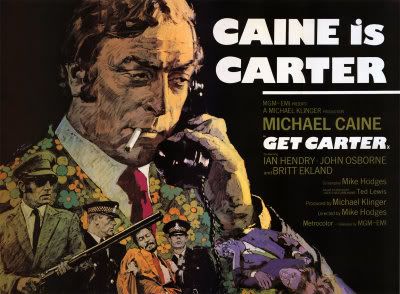
Last night I watched the 1971 movie "Get Carter," which Michael Cain playing the title role. It was a violent (though not visual disturbing because the special effects were so outdated; blood was very fake) movie with some extremely interesting moments. (As one reviewer on IMDB says, "as the film reaches its climax, the bodies begin to mount with alarming rapidity.") About two hours long, I found it to be a little long (the same reviewer describes it as a "slow-burner").
Check out the preview:
From here on out, this entire post is going to be one big spoiler and it is a movie that relies on suspense, so if you think you might see it; I'd just skip this post.
***SPOILER***
The plot is about Carter trying to uncover who murdered his brother. The movie includes several sexual detours; Carter has sex with ever women he has any dialogue with in the movie, excluding his niece/daughter and his dead brother's girlfriend (I'll get to that). He has sex with his boss's girlfriend (I'm counting phone sex as sex because it was a very erotic scene, and also, they've clearly had sex in the past), the woman who runs the bed and breakfast he's staying in, the girlfriend of at least two mob bosses in the movie. There are only two other women in the movie (that have any dialogue): Carter's niece (or possibly daughter, since it comes out in the movie that he's had an affair with her now deceased mother and that no one knew who fathered the baby. Even dead women have had sex with Carter.) and his brother's girlfriend.
The mystery of who killed the brother hinges on this porn movie that Carter discovers; it turns out that Carter's niece/daughter had been lured into the world of porn (Interesting thing about the porn: Carter is upset/disturbed when the porn begins; it's his niece and another woman, but the thing that puts him over the edge [he starts to cry and has to look away] is when a man enters the room and begins to have sex with the niece/daughter]). As for the brother's girlfriend, Margaret, Carter decides to set up the man who killed his brother, using Margaret. He kidnaps her, makes her strip down, and then injects something in her that kills her (you can see parts of this in the preview). He leaves her naked body on property of the man who killed his brother and then calls the police. Presumably everyone thinks she's the victim of a sexual assault.
At the end of the movie, Carter gets his, shot in the head by another professional killer. As a viewer, you want to see Carter successfully revenge his brother's death, but once he begins killing people (after he's seen the porn with his niece), he completely loses it and it becomes difficult to sympathize with him or to see him as anything other than a psychopath, who's revenge engulfs several, if not completely innocent, then close to innocent players, including two of the women.
What has supposedly driven Carter mad (and also got his brother murdered) was the niece's participation in this porn. When Carter is killing one of the men he screams at him, "How would you like it if that were your daughter?" Carter also watches, completely devoid of emotion, as one of the women (who he has locked in the trunk of his car after watching the porn [after they had sex]) who was in the porn with the niece, is drowned when the car is pushed into the ocean by people who have just tried to kill him. Carter himself murders Margaret, who's main crime it seems was not being that into Carter's brother and also "setting Carter up" (by calling the men who were chasing Carter). She may have also been in the porn, it was hard to tell.
In Carter's mind, and maybe in the world of the movie, there is one and only one innocent women, the niece/daughter. Carter never makes the connection, and the viewer isn't intended to either, in my opinion, that all of the women are potentially someone's daughter, sister, mother, wife, etc.
And maybe that's a good thing. To me, there's a fundamental problem with using a woman's relationship to others as grounds for treating women with respect (or at least with not murdering them callously). I mean, at no point in Get Carter did one character say to another "how would you feel if that were your son?!" while men were being thrown off buildings, shot, and knifed. There's something in that relationship-model that reeks of owner ship. (It was my niece, my daughter, my sister, my wife, my mother.) While using the "what if it were your daughter" line of reasoning may call upon someone's tender feelings for their relative, I think that at least in part it also relies on the indignity generated from imaging having one's possession damaged in some way.
I generally like movies where characters "do not learn their lesson" because I think those movies are much more true to life; usually situations are too complicated to take a simple lesson from them and often people cannot change who they are in that light-bulb moment, if ever. Carter never examined why he was so outraged when it was his niece who was used in a porn and why he could care a less (or feel violently angry towards) the other women who were used in the same porn. If the viewer examines why, I hope they don't walk away with the lesson "I wouldn't want to hurt a women, because all women belong to other people (ie are someone's mother, daughter, etc.)." That's a pretty sophomoric way of mastering gender equality.
Thursday, August 21, 2008
Easing back into blogging
Reading List:
*
- Thomas Frank, The Wrecking Crew: How a gang of right-wing con men destroyed Washington and made a Killing, Harper's August 2008
*
Listen to:
And
Invisible Worlds
*

*
"The USA Foundation's motto was 'Promoting a free market of ideas on the nation's campuses,' and here we encounter yet another of the Washington right's signature lines. Like so many conservative ideas---anticommunism for example---it sounds fine at first. A 'free market of ideas' sounds like 'free inquiry' or a 'free exchange of ideas,' an environment in which hypotheses are tested and bad ones are wedded out while good ones go on to earn the respect of the community of scholars. But this is not what the phrase means at all. Markets do not determine the objective merit of things, only their price, which is to say, their merit in the eyes of large corporations and the very wealthy."
- Thomas Frank, The Wrecking Crew: How a gang of right-wing con men destroyed Washington and made a Killing, Harper's August 2008
*
Listen to:
And
Invisible Worlds
*

Wednesday, August 20, 2008
Radio junky
Check out NPR's "Hearing Voices" podcast. Here's where you can listen to past episodes. At least a few episodes are hosted by Scott Carrier, one of my favorite contributors on This American Life.
Wednesday, July 9, 2008
So many books about food
Something has been bothering me about Michael Pollen's book Omnivore's Dilemma. Pollen writes,
I've just finished Sharman Apt Russel's amazing book "Hunger: An Unnatural History," which among other things, discusses the physiological aspects of fasting, the various ways fasting has been used throughout history, and the Western world's response to hunger epidemics.
Here is a bit of what Russel writes about China,
Pollen clearly critiques the industrial food complex in Omnivore's Dilemma. I believe that Pollen's position can be summed up succiently from this one paragraph from the first essay in Wendell Berry's book "Another Turn of the Crank." Berry writes,
Pollen and Berry make it seem like such a clear cut choice, eat local [reject global] and you will be choosing the more environmental sound, healthier, and more animal-friendly route. To Pollen, our movement away from all these benefits has at least some its origins in the development of fertilizer from synthetic nitrogen, which shifted us away from solar based farming and onto fossil fuel based farming. But the phrase I keep returning to in that passage I quoted above from Omnivore's Dilemma is "grind to a very painful halt." Pollen goes onto to say that one of Haber's biographers "estimates that two of every five humans on earth today would not be alive if not for Fritz Haber's invention." When you put that "painful halt" in the context of very real famines that have occurred, that are occurring, during our lifetimes, I feel less certain about what my food choice mean and if I can live with what they might mean.
 Lettuce and strawberries from my local farmer's market.
Before Fritz Haber's invention [of synthetic nitrogen] the sheer amount of life earth could support---the size of crops and therefore the number of human bodies---was limited by the amount of nitrogen that bacteria and lightening could fix. By 1900, European scientists recognized that unless a way was found to augment this naturally occurring nitrogen, the growth of the human population would soon grind to a very painful halt. This same recognition by Chinese scientists a few decades later is probably what compelled China's opening to the West: After Nixon's 1972 trip the first major order the Chinese government placed was for thirteen massive fertilizer factories. Without them, China would have probably starved.
I've just finished Sharman Apt Russel's amazing book "Hunger: An Unnatural History," which among other things, discusses the physiological aspects of fasting, the various ways fasting has been used throughout history, and the Western world's response to hunger epidemics.
Here is a bit of what Russel writes about China,
The biggest famine in recorded history also took place in the middle of the twentith century...When [Chairman Mao] wanted China to become a great producer of grain, he collectivized the peasant's farms and insisted on unscientific methods of growing crops that inadvertantly reduce production. Under intense pressure, peasants and officials competed to grow the most food. Harvests were reported at twice, three times, a hundred times their actual yield. Delighted with these inflated numbers, Mao and the party took a percentage of the grain to be stored near urban centers. Sometimes that percentage was the entire real harvest, leaving nothing for the people in the countryside. At the same time China cut its imports of food and doubled its exports. As people began to starve, Mao ignored them.
...
By the end of 1960, even cities suffered from a lack of food since few farmers had had the strength to plant new crops...Meanwhile, in many areas, the grain stored by the state was left to rot.
...
Outside China, no one guessed at the extent of the disaster until the mid-1980s when China released census date that researchers could match with other accounts. Thirty to forty million people had starved to death.
Pollen clearly critiques the industrial food complex in Omnivore's Dilemma. I believe that Pollen's position can be summed up succiently from this one paragraph from the first essay in Wendell Berry's book "Another Turn of the Crank." Berry writes,
If communities of farmers and consumers wish to promote a sustainable, safe, reasonably inexpensive supply of good food, then they must see that the best, the safest, and most dependable source of food for a city is not the global economy, with its extreme vulnerabilities and extravagant transportation costs, but its own surrounding countryside. It is, in every way, in the best interest of urban consumers to be surrounded by productive land...
Pollen and Berry make it seem like such a clear cut choice, eat local [reject global] and you will be choosing the more environmental sound, healthier, and more animal-friendly route. To Pollen, our movement away from all these benefits has at least some its origins in the development of fertilizer from synthetic nitrogen, which shifted us away from solar based farming and onto fossil fuel based farming. But the phrase I keep returning to in that passage I quoted above from Omnivore's Dilemma is "grind to a very painful halt." Pollen goes onto to say that one of Haber's biographers "estimates that two of every five humans on earth today would not be alive if not for Fritz Haber's invention." When you put that "painful halt" in the context of very real famines that have occurred, that are occurring, during our lifetimes, I feel less certain about what my food choice mean and if I can live with what they might mean.
 Lettuce and strawberries from my local farmer's market.
Subscribe to:
Posts (Atom)
