Showing posts with label voting. Show all posts

Thursday, September 11, 2008

Hands off my ballot

Earlier this summer, Alternet reported that McCain would be scaling back voter suppression efforts that have been used in previous elections. Via Wonkette, I came across this piece in the Michigan Messenger.

The chairman of the Republican Party in Macomb County Michigan, a key swing county in a key swing state, is planning to use a list of foreclosed homes to block people from voting in the upcoming election as part of the state GOP’s effort to challenge some voters on Election Day.
This really pisses me off and I think it should piss you off as well.

Check this quote from The Right to Vote page on USInfo.State.Gov from the U.S. Department of State,

Without free and fair elections, there can be no democratic society, and without that constant accountability of government officials to the electorate, there can, in fact, be no assurance of any other rights. The right to vote, therefore, is not only an important individual liberty; it is also a foundation stone of free government.

Who shall have that right has been a persistent question in American history. A theme that runs throughout the American past is the gradual expansion of the franchise, from a ballot limited to white, male property-owners to a universal franchise for nearly everyone over the age of 18. A related theme is ensuring the full equivalency of each vote, insofar as that is possible within a federal system. But because Americans often take this right for granted, it has not always been exercised as fully as it should be. With nearly 200 million citizens eligible to vote, too many people think their individual ballot will not count. The closeness of the presidential election of 2000 has served as a reminder that every vote does count, however.

[emphasis mine]

News flash for the government: People don't think that their vote won't be counted because we have too many citizens and they've taken the right to vote for granted, they think their vote won't be counted because (1) the U.S. has a long history of limiting voting rights to classes that are already in power (white, landowning men, anyone?---read further on that Right to Vote page for more history), (2) because every year there seem to be more and more efforts to prevent people from voting successfully (please check out this page detailing some different state's requirements for voter ID laws and also the piece I previously wrote about Indiana's voter ID laws), (3) it is really difficult to trust electronic voting machines because of all the controversy around 'em, and (4) a significant portion of the population feel as though officials that they have elected ignore them once they get into office (ie, my vote might be literally counted, but does it count?).

Personally, I'm going to be stopping by my local Obama office this afternoon to ask them if they're providing literature to voters about their voting rights in Virginia. (FYI, according to The National Conference of State Legislatures [linked above, but please please check out this page], VA voters who do not have a VA voter registration card, social security card, VA driver's license, other ID issued by the VA/U.S. govt, or an employee ID card with photo, can still vote, they just have to sign a statement that says they are who they say they are. I don't want anyone telling a Virginian that they can't vote because they don't have ID.)

Supported by the GOP as necessary to protect against voter fraud, these laws have the effect of making it more difficult to vote. Under the Indiana law, for example, a voter without a photo ID either has to come back on Monday after the election with one or "execute an affidavit stating that the voter cannot obtain proof of identification, because the voter: (i) is indigent; or (ii) has a religious objection to being photographed." Even if a voter without a photo ID on November 4th is able to get one by November 10th or they fit the narrow exceptions, their vote will only be counted, if "the voter has not been challenged or required to vote a provisional ballot for any other reason."

From the Michigan Messenger piece, it's clear that the GOP is not going to stop at voter ID laws in its effort to restrict the right to vote of U.S. citizens in this year's presidential election. Imagine that you've lost your home this year. Imagine hearing that if you show up to vote, your vote might get challenged by the GOP based on the fact that you've lost your home (btw, as someone points out in the article, many people are still living in homes that have been foreclosed and therefore are still living where they registered and would be voting legally). I know what I would be thinking, "What if they challenge me publicly and tell everyone my home has been foreclosed on? That would be incredibly embarrassing [ED: I don't think there is anything shameful about not having the money to pay your mortgage, inflated or otherwise, but I can see feeling that way.]" That might prevent me from even trying to vote. And if I did go to vote, what happens to votes that get challenged? Do they only get counted if the district is really really close? (Does anyone know the answer to this?)

Possible Actions:

Ask John McCain to denounce this practice in Michigan.

Get in touch with Obama's Michigan campaign and make sure they know what's happening.

Help someone else in our state register to vote and fulfill our states voter ID requirements (and make sure local campaign offices are paying attention to voter ID requirements).

Keep writing in our own spaces about voter suppression tactics so people are aware of what's happening.

Fill out Progress Michigan's petition against this tactic.


Thursday, January 10, 2008

Must have Photo ID to Rock the Vote

Please check out this article from the New York Times on the case before the Supreme Court challenging the Indiana voter ID law. The law says that either you have to produce a photo ID when you vote or, if you don't have photo ID, vote provisionally and then go to the county courthouse within 10 days of voting to validate your vote. Proponents of the law claim that it is necessary to prevent in-person voter fraud. Challengers of the law claim that the law will, in effect, disenfranchise minorities, poor people, and elderly people, all of whom are less likely to have photo IDs. Voting is a fundamental right and this law infringes on that right, so the court should use "strict scrutiny" as their standard of review. (Sorry to use Wikipedia as a link, but I think this particular article does a good job summarizing strict scrutiny from what I can remember from my law school days.) Strict scrutiny means that the law must protect a compelling government interest and be narrowly tailored and use the less restrictive means to achieve that interest.

The Times article does a pretty good job of summing up how things are going (not well; divided along party lines). It really pisses me off and makes me sad that Kennedy said the law causes a "minor inconvenience" for people. I feel like he's not thinking about how truly difficult it is for some people to get to government office buildings during their hours of operation, because of the hours the person works, or not having child care, or being physically disabled. It has not been proven that there is any problem in the U.S. with in-person voter fraud, but I think it's entirely apparent that we do have a problem getting people out to vote at all. I think it's horrible that states are writing laws that make it more difficult for people to vote.

If this law gets upheld, then I really hope that registration drives start to include helping people obtain photo ID. I wonder if there is some kind of fund that could be put together to help people with the fees that accompany getting a photo ID in some states.

*

In international news, the Times reported yesterday that abortion clinics are shutting down in Spain, while the workers go on strike to protest the lack of government protection from violent and threatening pro-life protesters. I do think the Spainish government should do all it can to ensure the safety of the clinic workers and the women who use the clinics, but I can't help but think that by shutting down the clinics to protest, the clinic workers are hurting their own clients (an estimated 2,000 women will be affected) more than making a statement to the government or to the pro-life movement.

(Why does the NY Times author call the pro-life people "anti-abortion?" I would call them anti-choice. Out of politeness, I have chosen to call them pro-life here, but calling them "anti-abortion" implies the other side is pro-abortion. As I have said before, I believe both sides of this debate are committed to reducing the number of abortion; pro-life people generally believe that the way to do this is to make all abortion illegal and teach abstinence-only sex education and pro-choice people generally believe that the way to reduce the number of abortions is to keep it legal [read: safe] and promote pro-contraceptive sex education. It's disingenuous to present one side as anti-abortion and, in doing so, imply that the other side is pro-abortion. Although maybe the pro-life movement in Spain is commonly referred to as anti-abortion and that is why the NY Times has chosen this nomenclature.)

Wednesday, January 9, 2008

It's time to have a talk (aka LALALA I CAN'T HEAR YOU)

Ever since I saw this piece by Gloria Steinem about Hillary Clinton and the role of sexism in her campaign, I have been passing it around to friends. Well, after reading this piece by Angry Black Bitch and scrolling through the comments accompanying the post, I have to say I'm completely ashamed I didn't give more thought to Steinem's piece.

I know where Steinem's piece came from. As I glance around on the internet this morning, I see a lot of backlash against Clinton taking the form of sexist attacks. And that makes me angry, sad, and afraid.

However, even with Steinem's disclaimer that she knows all about the intersections of racism and sexism, the article still reads like this: "Obama, as a black man, has an easier time getting the democratic nomination than Clinton, as a white woman." This is a dangerous game because even as Steinem's disclaimer sits there shouting about how tangled up identities are, the rest of her article claims to separate out identities so neatly that supporting Clinton is supporting the (mythical single) cause of all women/feminism. This game is going to lead to a lot of shouting, a lot of deeply hurt feelings, and absolutely no resolution.

I am all for having discussions about the intersections of race and gender and I'm not about to tell people when they can and cannot have these discussions. I am just not looking forward to having this "discussion" played out on the national stage through presidential primaries and the subsequent presidential race. I'm apprehensive about this, mainly because I don't think it will be a discussion at all. Discussion requires an attempt to understand another person's opinion. I don't know if you've been on the internet lately, read a newspaper, turned on your television or radio, or stepped outside, but there's not a lot of that going on.

I see a lot of conversations about who the candidates are in these terms: Clinton is a woman, Obama is black, Huckabee is a preacher, Romney is rich, Kucinch/Paul are the outsiders. These handles tell us something about the candidates, but not much. The also tell us something about the candidates' supporters, but, again, not much. And I think, perhaps, they disguise a lot more than they tell. We are told again and again that voters care more about superficial aspects than they do about the "issues." Even when we care about the issues, our interest can supposedly be summed up in one easy phrase, "Change." How are voters supposed to care deeply about the issues when we are force-feed this cliff-note version of things? What does change mean? What do we mean when we say people support/don't support Clinton because she's a woman? What do we think being "a woman" means? What do we think being black means? What do we think being an white means? What do we think being rich means? What do we think being an outsider means? What do we think "we" or "the nation" means? WHAT ARE ALL THESE WORDS CODE FOR?

Wednesday, November 28, 2007

Apathy Mask

I recently finished reading "A People's History of U.S.," a book I've mentioned again and again here. As I neared the end of the book (and moved closer to present day) author Howard Zinn argues that the government has become disconnected from the people.

Zinn writes
After the disastrous war in Vietnam came the scandals of Watergate. There was deepening economic insecurity for much of the population, along with environmental deterioration, and a growing culture of violence and family disarray. Clearly, such fundamental problems could not be solved without bold changes in the social and economic structure. But no major party candidates proposed such changes. The "American political tradition" held fast.
In recognition of this, perhaps only vaguely conscious of this, voters stayed away from the polls in large numbers, or voted without enthusiasm. More and more they declared, if only by nonparticipation, their alienation from the political system.


Passages like this really stuck with me. My brother turned 18 a few years after Kurt Cobain killed himself. Interviewers were asking Cobain constantly if "Smells Like Teen Spirit" was about teenage apathy because the story of the time was that my brother's generation, the one right before mine, was apathetic. They didn't vote because they didn't care or so said the media.

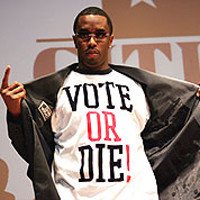
That story continues today. Sean Combs "Vote or Die" Campaign seems based on the idea that if teenagers and people in their twenties just really understood how incredibly important it is to vote, if they were just whipped into a frenzy, they would be voting.

But perhaps apathy masks something deeper and more frightening, despair.

Again, Zinn writes, "In a two party system, if both parties ignore public opinion, there is no place voters can turn."

The apathy story is a good one for the government and the media because it turns nonparticipation into individual moral failing (laziness, being uneducated, selfishness). The "despair" story is a much more difficult one because it requires us to admit the system is failing the people rather blame people for failing to participate in it.