Showing posts with label food. Show all posts

Wednesday, July 9, 2008

So many books about food

Something has been bothering me about Michael Pollen's book Omnivore's Dilemma. Pollen writes,
Before Fritz Haber's invention [of synthetic nitrogen] the sheer amount of life earth could support---the size of crops and therefore the number of human bodies---was limited by the amount of nitrogen that bacteria and lightening could fix. By 1900, European scientists recognized that unless a way was found to augment this naturally occurring nitrogen, the growth of the human population would soon grind to a very painful halt. This same recognition by Chinese scientists a few decades later is probably what compelled China's opening to the West: After Nixon's 1972 trip the first major order the Chinese government placed was for thirteen massive fertilizer factories. Without them, China would have probably starved.

I've just finished Sharman Apt Russel's amazing book "Hunger: An Unnatural History," which among other things, discusses the physiological aspects of fasting, the various ways fasting has been used throughout history, and the Western world's response to hunger epidemics.

Here is a bit of what Russel writes about China,

The biggest famine in recorded history also took place in the middle of the twentith century...When [Chairman Mao] wanted China to become a great producer of grain, he collectivized the peasant's farms and insisted on unscientific methods of growing crops that inadvertantly reduce production. Under intense pressure, peasants and officials competed to grow the most food. Harvests were reported at twice, three times, a hundred times their actual yield. Delighted with these inflated numbers, Mao and the party took a percentage of the grain to be stored near urban centers. Sometimes that percentage was the entire real harvest, leaving nothing for the people in the countryside. At the same time China cut its imports of food and doubled its exports. As people began to starve, Mao ignored them.
...
By the end of 1960, even cities suffered from a lack of food since few farmers had had the strength to plant new crops...Meanwhile, in many areas, the grain stored by the state was left to rot.
...
Outside China, no one guessed at the extent of the disaster until the mid-1980s when China released census date that researchers could match with other accounts. Thirty to forty million people had starved to death.

Pollen clearly critiques the industrial food complex in Omnivore's Dilemma. I believe that Pollen's position can be summed up succiently from this one paragraph from the first essay in Wendell Berry's book "Another Turn of the Crank." Berry writes,

If communities of farmers and consumers wish to promote a sustainable, safe, reasonably inexpensive supply of good food, then they must see that the best, the safest, and most dependable source of food for a city is not the global economy, with its extreme vulnerabilities and extravagant transportation costs, but its own surrounding countryside. It is, in every way, in the best interest of urban consumers to be surrounded by productive land...

Pollen and Berry make it seem like such a clear cut choice, eat local [reject global] and you will be choosing the more environmental sound, healthier, and more animal-friendly route. To Pollen, our movement away from all these benefits has at least some its origins in the development of fertilizer from synthetic nitrogen, which shifted us away from solar based farming and onto fossil fuel based farming. But the phrase I keep returning to in that passage I quoted above from Omnivore's Dilemma is "grind to a very painful halt." Pollen goes onto to say that one of Haber's biographers "estimates that two of every five humans on earth today would not be alive if not for Fritz Haber's invention." When you put that "painful halt" in the context of very real famines that have occurred, that are occurring, during our lifetimes, I feel less certain about what my food choice mean and if I can live with what they might mean.
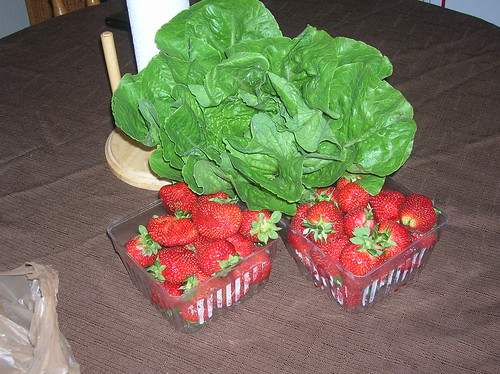

Lettuce and strawberries from my local farmer's market.

Tuesday, January 1, 2008

Happy New Year!

Last night, I celebrated the end of 2007 with good food and drink. For dinner I used a recipe from the Better Homes and Garden Vegetarian Cookbook to make "Miniature Mexican Frittatas."

Ingredients:
1 10 oz package frozen chopped spinach, thawed and well drained
1 C cottage cheese, drained
1/2 C grated Parmesan cheese
1/2 C shredded cheddar cheese (2 oz)
4 eggs
1/4 C milk
1 tsp ground cumin
1/4 tsp pepper
2 TBS snipped cilantro or parsley
Salsa, warmed
Sour cream (optional)

Directions:
Preheat the oven to 375 degrees.
In a medium bowl stir together the spinach, cottage cheese, parmesan cheese, and cheddar cheese. In another bowl stir together the eggs, milk, cumin, pepper, and cilantro. Combine the two bowls. Spoon the mixture into 12 lightly greased 2.5-in muffin cups. Bake for 20-25 min or until eggs are set. Cool for five minutes. Top with salsa and sour cream.

Here's what the finished product looked like:


While I was on my lunch break yesterday, I stopped at the Market Street Wine Shop to pick up some fancy-smancy beer. I love that store so much. I am a bread-fiend and their bread always looks so amazing. I've heard that on Mondays you can get bread-ends there for free, but I have yet to try it. Here (minus the champagne, which my parents gave me) is some of what I picked up:


For dessert, I broke out the muffin tins again to make cupcakes (from the box). Those suckers were really tricky to frost. I have too many of them on my hands now:

I did make a resolution for the New Year, which I am planning on writing more about later today or tomorrow. I generally make specific, goal-oriented resolutions like "go the the gym everyday" or "start writing fiction again," but this year I've decided to do something different. My resolution for the new year is embodied in the word "Give." I want to give more. I'm not sure how yet and I don't plan on settling on one specific way to give more. I'd rather just focus the idea of giving and see where it takes me. I already have one idea of something I would like to do with this, but that's for another post.

Saturday, September 29, 2007

For all you Lovers out there

Today I went to the Charlottesville Vegetarian Festival. While there I stopped by the Food Not Bombs' table and picked up some of their materials and signed up to be called to help out. The Charlottesville Food Not Bombs' group serves vegetarian/vegan meals to people in need of food at Tonlser Park at 1pm on Sundays. I have wanted to get involved with Food Not Bombs (this one will take you to their home page) for awhile. (I remember trying to during the summertimes in Pittsburgh to find a Pittsburgh chapter, but I must not have tried very hard [or they must have recently got things up and running] because a quick search took me to this page.) Anyway, check out the Food Not Bombs links above; the group has had some interesting history.

(Thinking about Food Not Bombs today lead me to search for mention of "Better than Television," in Charlottesville. I don't think they exist anymore. Does anyone know? Anyway, that lead me to Slingshot "a quarterly, independent, radical, newspaper published in the East Bay since 1988 by the Slingshot Collective." [And I take issue with the first person's statement that cervical cancer is easily cured if detected early--what about people who do not have access to annual cervical exams?])

Finally, on two totally unrelated notes, I am in the midst of a cold and had my first nose bleed ever today and I'm reading "Remembrance of Things Past" and thought I would share this passage,

At this time of life one has already been wounded more than once by the darts of love; it no longer evolves by itself, obeying its own incomprehensible and fatal laws, before our passive and astonished hearts. We come to its aid, we falsify it by memory and by suggestion. Recognizing one of its symptoms, we remember and recreate the rest. Since we know its song, which is engraved on our hearts in its entirety, there is no need for a woman to repeat the opening strains---filled with the admiration which beauty inspires---for us to remember what follows.

Tuesday, September 25, 2007

Moo

Yesterday morning I heard this segment on NPR's Morning Edition about the rising cost of dairy products. As the segment explains, although milk is generally a local product, the price of skim-milk powder, which is used in many products, has risen. Dairy producers may focus on making skim-milk powder, increasing the shortage in milk production (which is already increasing for many reasons as the NPR segment explains). As supplies go down, prices go up.

After hearing this piece, I realized I had no idea where Harris Teeter, one of the local grocery stores, gets its milk. A quick google search didn't get me any closer to finding out, but I did run into Majesty Farm's Cow and Goat Share Program. As the link explains, the cow and goat share program allows people to buy "stock" in a goat or cow; the price of the stock includes the farm boarding and feeding your animal, regular vet visits, daily milking, and 1 gallon of milk a week per "cow share" or 3 quarts for a "goat share." The program allows people to get around laws prohibiting buying and selling raw milk (it's not illegal to own/drink milk from animal you own). It's too expensive for me, but I thought it was an interesting idea worth sharing.

Also, if you're like me, you may have run out of This American Life episodes to listen to. If so, I highly recommend Radio Lab.